
In the mid-2010s, a small clause in the US Internal Revenue Code attracted almost no attention outside specialist tax circles. By the early 2020s, it had become one of the most consequential procurement drivers in the American renewable energy sector. Today, "Safe Harbor" governs the timing, structure, and sourcing decisions of nearly every large-scale solar project in the United States.
Understanding why — and understanding what it means for international transformer manufacturers — requires a brief detour into US energy tax policy.
What Safe Harbor Actually Means
The Investment Tax Credit (ITC) and Production Tax Credit (PTC) that underpin US renewable energy economics are tied to a project's "start of construction" date. The IRS permits developers to demonstrate this start through one of two methods: the Physical Work Test, or the Five Percent Safe Harbor. Under the latter, a developer who pays or incurs at least 5% of a project's total cost before a specified deadline is deemed to have "begun construction" and locks in the applicable tax credit rate — regardless of when the project actually reaches commercial operation.
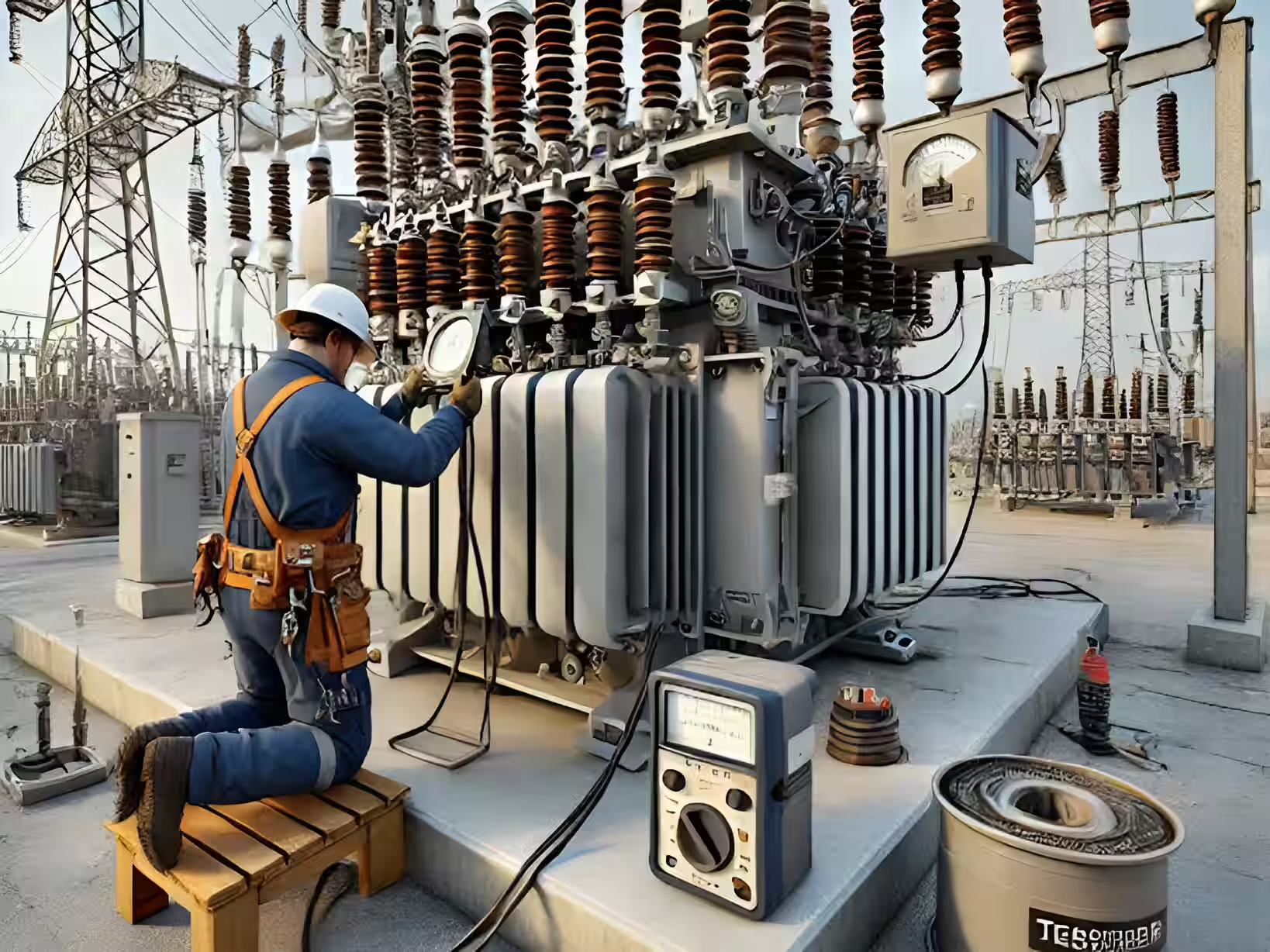
"Safe Harbor has turned transformer procurement into a strategic, time-sensitive decision. Developers who move fast — and source from qualified manufacturers — capture tax credits worth millions per project."For solar developers, the most natural way to satisfy this threshold is to purchase the most expensive long-lead-time equipment: the power transformers and pad-mounted transformers that connect a solar farm to the grid. A single large generator step-up transformer (GSU) for a utility-scale project can represent 4–8% of total project cost on its own. Pay the deposit, place the order, and the Safe Harbor clock is started.
Why This Creates Opportunity — and Complexity
The Safe Harbor mechanism has dramatically expanded the addressable market for transformer manufacturers willing to serve US solar developers. But it has also raised the bar significantly. Developers need manufacturers who can provide binding purchase agreements, accept progress payments, issue compliance documentation (including milestone-based progress reports), and demonstrate technical qualification to ANSI/IEEE and UL standards — not just IEC.
Most international transformer manufacturers have no experience navigating this framework. The documentation requirements alone — progress reports tied to specific milestones, compliance with buy-American provisions where applicable, UL listing for pad-mounted units — can be barriers that rule out otherwise capable suppliers.
Marsons' Approach to the US Market
Over the past two years, Marsons has built a US-market capability that goes beyond simply offering transformers at competitive prices. We have invested in understanding the technical standards — ANSI C57.12.00, IEEE C57.12.28, UL 1277, DOE 10 CFR Part 431 — that govern transformer procurement in the United States. We have developed prototype-tested designs for pad-mounted distribution transformers, three-winding generator step-up units, and large power transformers up to 345 kV and 300 MVA.
Critically, we have built the commercial and documentation infrastructure to support Safe Harbor transactions: structured purchase agreements, milestone-linked progress reporting, and compliance evidence packages that give project finance lenders and tax equity investors confidence. For developers like FTC Solar and portfolio managers like Emeren, this combination of technical qualification and commercial sophistication is what distinguishes a credible international supplier from a name on a quote sheet.
The Broader Lesson
The US solar transformer market is a proving ground — technically demanding, commercially complex, and highly visible to global project finance. Indian manufacturers who succeed here do not just win US orders. They demonstrate, to the world, that Indian engineering can meet the highest international standards. At Marsons, that demonstration has been six decades in the making.