There is a transformer somewhere in India — possibly in a remote substation in Assam, possibly in a steel plant in Jharkhand — that has been running continuously since the 1970s. It was built at Marsons' factory in Maheshtala, on the south bank of the Hooghly river, using copper wound by hand and core steel cut by craftsmen who learned their trade from the generation before them. It has never failed.
We tell that story not to boast, but because it captures something essential about what transformer manufacturing actually is. It is not a product business in the conventional sense. It is a commitment — a long-term wager that the engineering choices made in the factory today will still be justified when the unit is opened for inspection twenty years from now.
"A transformer is not a commodity. It is a considered engineering decision, embedded in steel and copper, that will live inside a substation for three decades."What 65 Years Actually Teaches You
Companies that have manufactured transformers for six decades carry a body of knowledge that cannot be acquired quickly. They have seen insulation systems age and fail in unexpected ways. They have learned which thermal gradients matter and which can be tolerated. They have built repair records and failure analysis databases that inform every new design. They have developed a physical intuition — distributed across hundreds of engineers and skilled workers — for the difference between a transformer that will merely pass a type test and one that will run reliably for thirty years in a harsh tropical environment.
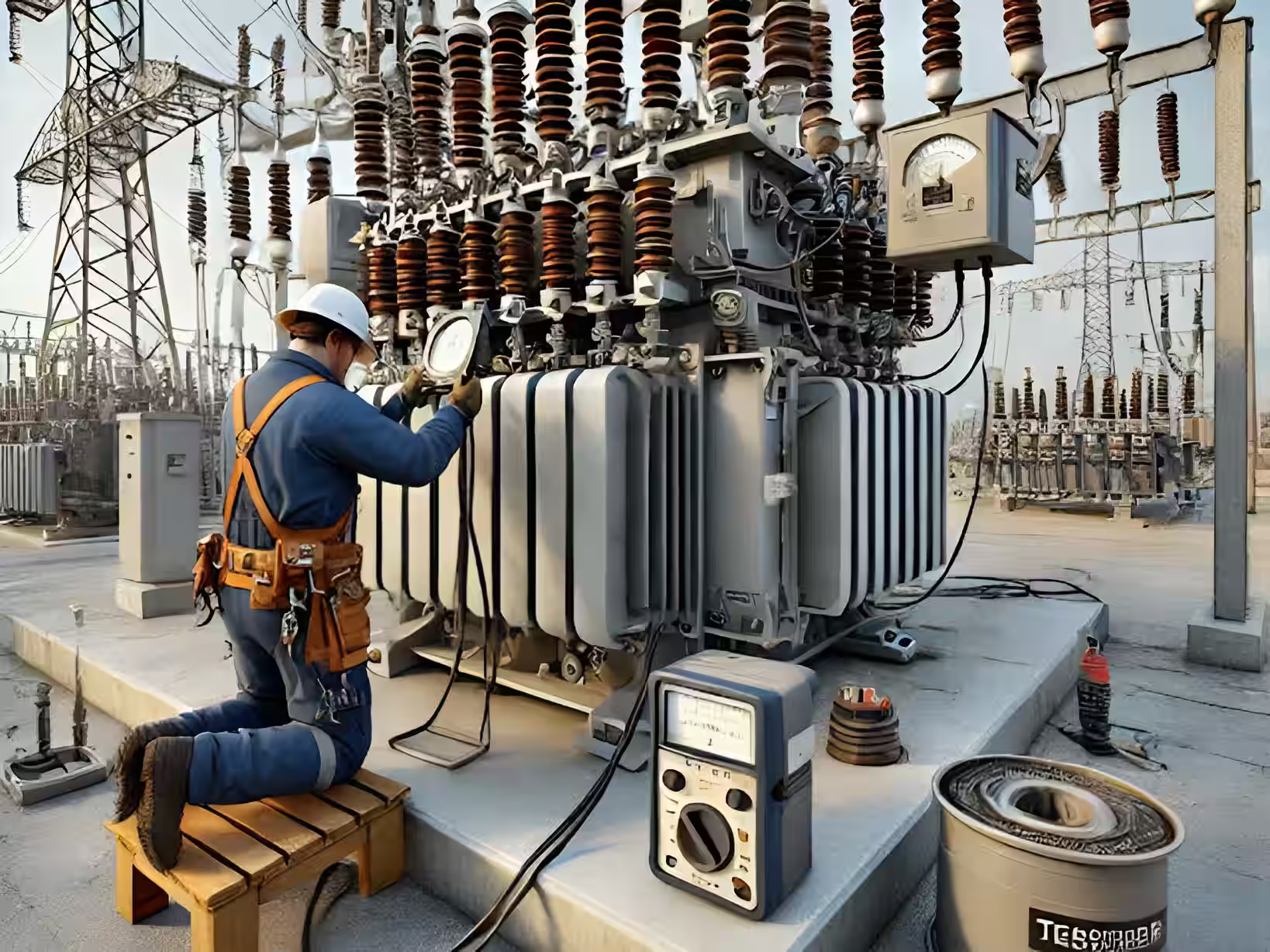
Marsons was founded in 1959, when India's industrial infrastructure was being built from scratch and transformer manufacturers were few. In those early decades, the technical partnerships forged, the standards adopted, and the testing disciplines established created a DNA that persists today. Our NABL-accredited laboratory — capable of performing impulse tests at 1,600 kV, short-circuit tests, temperature-rise tests, and partial discharge measurements — is not just a compliance facility. It is the physical embodiment of that institutional knowledge.
The Breadth That Depth Makes Possible
Six decades of accumulated expertise has also made it possible to serve markets that narrow specialists cannot. Marsons today manufactures distribution transformers as small as 10 KVA alongside power transformers approaching 300 MVA. We supply traction transformers for Indian Railways' most advanced electric locomotives and furnace duty units for electric arc furnaces operating at 50 kA. We make wind turbine generator transformers for the renewable energy sector and industrial duty transformers for some of India's largest manufacturing groups.
This breadth is not accidental. It reflects a deliberate belief that excellence in transformer manufacturing is transferable across voltage classes and application types — that the discipline required to build a reliable distribution transformer is the same discipline required to build a reliable furnace duty unit. You cannot fake process control or testing rigour at the small end and then suddenly apply them at the large end. The culture either exists across the factory or it does not exist at all.
Trust Is Built in Decades, Lost in Moments
The transformer industry is not one where marketing wins contracts. Procurement engineers at power utilities, industrial companies, and renewable developers have long institutional memories. They remember which manufacturer delivered on time. They remember which unit failed in service. They talk to each other. In a market built on trust accumulated over decades, reputation is a more durable competitive advantage than price.
This is why Marsons has continued to invest — in testing capability, in engineering talent, in process certification (ISO 9001, 14001, and 45001), in CPRI type tests — even during periods when the market did not immediately reward that investment. The next order, and the order after that, depends on the credibility earned from every unit that has gone before.
Three hundred thousand transformers. Sixty-five years. One thread running through all of it: the conviction that if you build something properly, it will last — and so will the relationship with the customer who relies on it.